Last updated: 2026-03-16, Originally published
Interior Basement Waterproofing vs. Exterior Methods: Which Is Right for Your Home?
Quick Answer: Interior basement waterproofing manages water after it enters your foundation using French drains, sump pumps, and vapor barriers. Exterior waterproofing stops water before it reaches your walls through membrane coatings and drainage. Most New England homes benefit from interior systems because they’re less disruptive, more affordable, and handle the region’s freeze-thaw cycles effectively.
Interior basement waterproofing is the most common fix for wet basements across Greater Boston and New England. But it’s not the only option. Exterior methods work from the outside to block water at the source.
Choosing the wrong approach wastes money and leaves your basement vulnerable. In this post, we cover what causes basement water problems, how each method works, cost and lifespan comparisons, and when to call a professional.
According to the American Society of Home Inspectors (ASHI), over 60% of American homes have below-grade moisture problems. The Insurance Information Institute reports that water damage claims average $12,514 per incident. For homes built on glacial till soils, marine clay deposits, and high water tables, the risk runs even higher.
Contents
- What Causes Basement Water Problems?
- How Does Interior Basement Waterproofing Work?
- How Does Exterior Basement Waterproofing Work?
- Interior vs. Exterior: How Do Costs and Lifespans Compare?
- Which Method Fixes Your Specific Water Problem?
- Can You Use Both Methods Together?
- How Does Basement Water Affect Your Health and Home Value?
- Why Does Climate Matter for Basement Waterproofing?
- What Maintenance Keeps Your Waterproofing System Working?
- When Should You Call a Waterproofing Professional?
- Frequently Asked Questions
- Protect Your Basement Today
What Causes Basement Water Problems?
Basement water enters through three main forces: hydrostatic pressure, capillary action, and condensation. Hydrostatic pressure builds when groundwater pushes against your foundation walls and floor. Capillary action pulls moisture through tiny pores in concrete.
Condensation forms when warm air meets cool basement surfaces. Understanding which force is at work determines whether you need interior or exterior protection.
Hydrostatic pressure is the most destructive of the three. After heavy rain or snowmelt, the soil around your foundation becomes saturated. Water follows gravity and collects at the lowest point, your basement floor.
The U.S. Department of Energy puts this in perspective. A single inch of rain on a 1,000-square-foot roof produces 620 gallons of water directed toward your foundation.
Capillary action works more slowly. Concrete is porous, and moisture wicks through it the way a paper towel absorbs a spill. You’ll notice damp spots on walls or a white, chalky residue called efflorescence.
This mineral deposit means water has been traveling through your concrete for a while.
Cracks in your foundation give water an easy path. Poured concrete walls develop shrinkage cracks as they cure. Concrete masonry unit (CMU) block foundations have mortar joints that erode over time.
Either type can let water in when the soil outside becomes saturated. We’ve seen homes where a single hairline crack let gallons of water in during every Nor’easter. Once you know the source, the next step is choosing the right fix.
How Does Interior Basement Waterproofing Work?
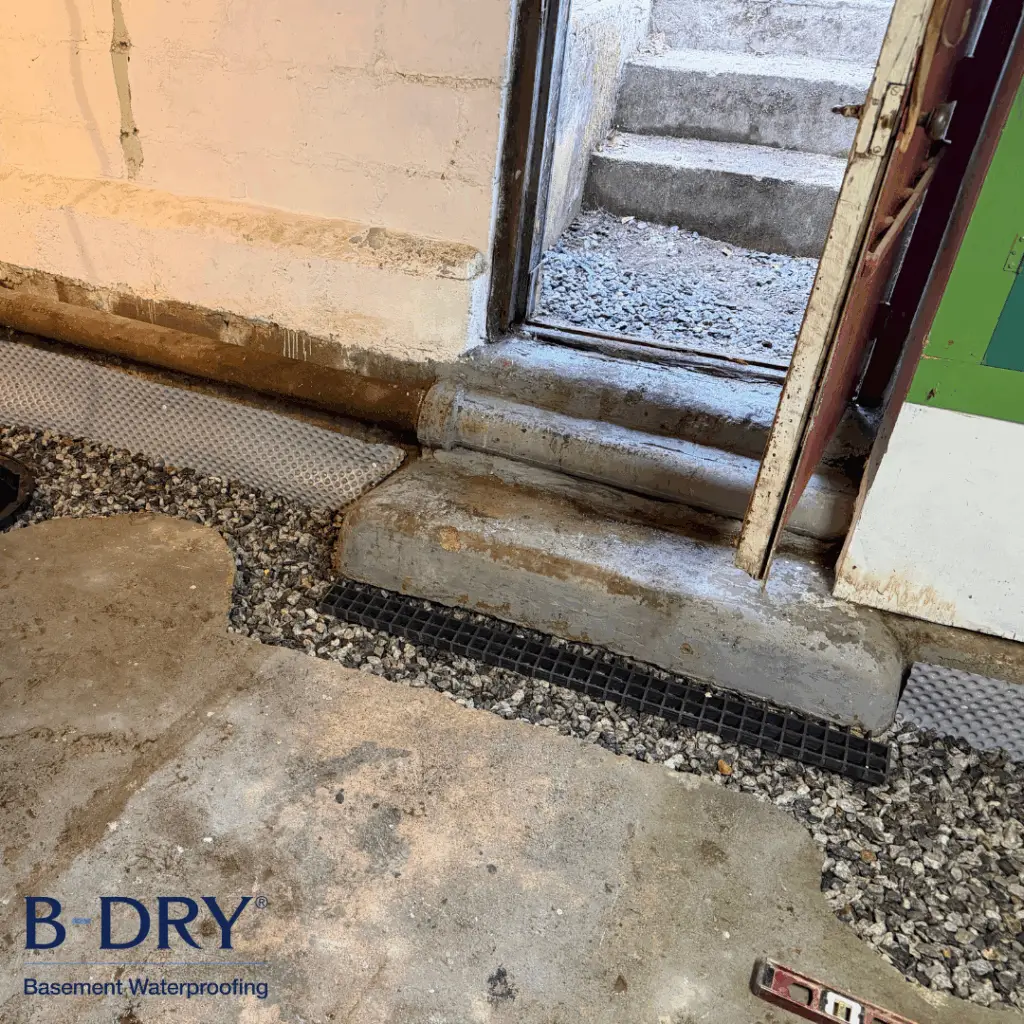
Interior basement waterproofing collects water that enters your foundation and channels it to a sump pump for removal. A perimeter French drain sits beneath your basement floor along the walls.
Water flows into this drain by gravity, travels to a sump pit, and gets pumped out and away from the home. This approach manages water reliably without any exterior excavation.
The installation follows these steps:
- Cut a narrow channel around the basement perimeter along the foundation walls.
- Lay perforated drain pipe in the channel, surrounded by clean crushed stone for filtration.
- Route the drain pipe to a sump pit at the lowest point of the basement.
- Install a sump pump with automatic float switch activation in the pit.
- Connect a discharge line to carry pumped water away from the foundation.
- Patch the concrete floor over the drainage system, leaving it hidden.
- Mount vapor barriers on basement walls to direct seepage into the French drain.
In our experience, a properly installed French drain system handles even the heaviest water intrusion. The sump pump activates automatically when water reaches a set level and pushes it through the discharge line to the surface. Battery backup units keep the system running during power outages, which often coincide with major storms.
Pro Tip: Always pair your sump pump with a battery backup unit. Power outages during storms are exactly when your pump works hardest. A backup gives you 8-12 hours of protection when the grid goes down.
Vapor barriers add another layer of protection. These heavy-duty plastic sheets mount on your basement walls, directing any moisture that seeps through the concrete down into the French drain. They also block humidity from migrating through the walls.
Paired with a dehumidification system, vapor barriers keep your basement dry and comfortable year-round. But how does the exterior alternative compare?
How Does Exterior Basement Waterproofing Work?
Exterior waterproofing creates a barrier on the outside of your foundation walls to prevent water from ever reaching the concrete. Crews excavate soil down to the footing, apply a waterproof membrane or coating, and install exterior drain tiles. This method stops water at the source but requires heavy equipment and significant landscaping disruption.
The membrane is the centerpiece. Modern systems use rubberized asphalt or thermoplastic polyurethane (TPU) sheets that bond directly to the foundation wall. Products like Henry Blueskin WP 200 or Carlisle CCW MiraDRI meet ASTM D6135 standards for below-grade waterproofing.
These materials flex without cracking as your foundation shifts with seasonal temperature changes. A dimpled drainage board (such as Delta-MS by Dorken) goes over the membrane to protect it from backfill and channel water downward.
Exterior drain tiles work like interior French drains, but they sit at the base of your foundation on the outside. Water that moves through the soil hits the drain tile before it can press against your walls. This reduces hydrostatic pressure significantly.
The American Society of Home Inspectors (ASHI) considers exterior drainage one of the most effective long-term solutions for new construction.
The biggest drawback is the scope of work. Excavating around a home means digging 6-8 feet deep along the entire perimeter. Decks, porches, driveways, walkways, and landscaping in the way need removal and replacement.
For older homes with mature plantings and established hardscaping, the disruption can be substantial. So how do the two approaches stack up on cost and longevity?
Interior vs. Exterior: How Do Costs and Lifespans Compare?
Interior waterproofing typically costs $3,000 to $7,000 for a standard basement, while exterior waterproofing runs $8,000 to $15,000 or more. Interior systems install in 1-3 days with no outdoor disruption.
Exterior projects take 1-2 weeks and require heavy excavation. Both methods can last decades with proper maintenance, though interior systems are far easier to service and repair.
| Factor | Interior | Exterior |
|---|---|---|
| Average cost | $3,000 – $7,000 | $8,000 – $15,000+ |
| Installation time | 1-3 days | 1-2 weeks |
| Excavation needed | No | Yes, full perimeter |
| Landscaping impact | None | Significant |
| Best for | Existing homes, active leaks | New builds, severe wall damage |
| Typical lifespan | 25+ years (with maintenance) | 25+ years |
| Year-round install | Yes | No (ground can’t be frozen) |
| Ease of repair | Accessible from inside | Requires re-excavation |
Cost alone doesn’t tell the full story. Interior systems offer a faster return on investment because the installation cost is lower and the protection starts immediately. We’ve seen homeowners spend $15,000 on exterior work only to still need an interior drain.
Water often finds a new path through the floor slab. That said, exterior waterproofing has a genuine advantage for new construction or homes with deteriorating foundation walls. It stops water contact with the concrete entirely, reducing long-term material degradation.
The Bob Vila Cost Guide reports that 85% of residential waterproofing projects nationwide use interior methods. The reason is practical: most water problems in existing homes respond well to interior drainage, and the work doesn’t depend on weather or season. The next step is matching the method to your specific symptoms.
Which Method Fixes Your Specific Water Problem?
The best waterproofing method depends on where water appears and how it behaves. Wall seepage along the floor joint points to hydrostatic pressure, which an interior French drain handles.
Cracks leaking mid-wall may need injection repair or an exterior membrane. Standing water after storms calls for a sump pump.
Water pooling at the wall-floor joint: This is hydrostatic pressure pushing water up through the cove joint where your wall meets the floor. An interior perimeter drain captures this water before it spreads. This is the most common water entry point we see in homes across the region.
Cracks leaking in poured concrete walls: Vertical cracks from foundation settling or shrinkage often respond to epoxy or polyurethane injection repair. The injection fills the crack from inside and bonds to the concrete.
Damp or wet block walls: Concrete block walls are hollow. Water fills the block cores and seeps through mortar joints.
Interior drainage combined with a vapor barrier system addresses this effectively. The vapor barrier directs all moisture into the drain channel.
Bowing or bulging walls: This can signal a serious structural issue. Contact a qualified structural engineer or foundation-repair specialist for an evaluation.
Don’t ignore bowing walls. They can lead to foundation failure.
Humidity without visible water: If your basement feels damp but you can’t find a leak, moisture is likely wicking through the concrete. A combination of vapor barriers and a dehumidification system solves this without major construction. In some cases, using both interior and exterior methods provides the best result.
Can You Use Both Methods Together?
Combining interior and exterior waterproofing gives you the strongest possible protection against basement moisture. The exterior membrane blocks water at the foundation wall. The interior French drain catches anything that gets past the first line of defense.
This layered strategy makes sense for homes with severe water problems, high water tables, or finished basements where damage prevention is critical.
Not every home needs both systems. In fact, most don’t. A well-designed interior drainage system handles the vast majority of residential water problems on its own.
The B-Dry System, for example, has protected tens of thousands of homes with its patented interior approach.
A combination approach makes the most sense when you’re already planning exterior work. If you’re replacing a foundation wall, regrading your yard, or building an addition, adding an exterior membrane during that project is cost-effective. You’re already doing the excavation, so the incremental cost is much lower than a standalone exterior job.
Think of it like this: interior waterproofing is your primary defense. Exterior waterproofing is an optional upgrade that reduces the workload on your interior system. One without the other works fine.
Together, they create redundancy that gives homeowners peace of mind. Beyond keeping water out, waterproofing also protects your health and property value.
How Does Basement Water Affect Your Health and Home Value?
A wet basement creates conditions for mold growth, which the EPA says begins within 24-48 hours of water exposure. Basement moisture also drives radon gas accumulation, responsible for 21,000 lung cancer deaths annually per EPA estimates. Waterproofing protects your family’s health and your home’s resale value.
The financial impact is equally significant. The National Association of Realtors reports that water damage or evidence of moisture problems reduces a home’s value by 10-15%.
Buyers and home inspectors look for signs of water in every basement. Stains, efflorescence, musty odors, and visible mold all raise red flags during a sale.
Insurance companies also pay attention. Many standard homeowner policies exclude gradual water damage from coverage. That means if your basement has been slowly leaking and causes mold or structural damage, your claim may be denied.
Proactive waterproofing protects you from that coverage gap. We’ve worked with homeowners who saved thousands in potential claims by addressing their water issues before they grew.
Did You Know: The EPA reports that 40% of a home’s air comes from the basement through a process called the “stack effect”. Mold, radon, and humidity in your basement directly affect the air quality on every floor above it. EPA Radon Resources
Your local climate plays a major role in which waterproofing method works best for your home.
Why Does Climate Matter for Basement Waterproofing?
Freeze-thaw cycles, snow loads, and seasonal water table shifts all influence which waterproofing method performs best. In cold climates, frost heave opens new foundation cracks each winter, and spring snowmelt saturates soil rapidly. The right system accounts for these seasonal patterns, not just a single rain event.
The Massachusetts Building Code (780 CMR) sets the frost line at 48 inches below grade, deeper than most mid-Atlantic states. Your foundation footings sit at or below this depth.
During winter, soil above the frost line freezes and expands. That expansion pushes against your walls with thousands of pounds of lateral pressure. When it thaws, the soil contracts and leaves gaps where water collects.
Spring is the most critical season. The combination of snowmelt and spring rain saturates soil quickly. The ground is still partially frozen at deeper levels, so water can’t drain downward as fast as it accumulates.
This creates intense hydrostatic pressure against your foundation for weeks at a time. An interior drainage system stays active through this entire period because it operates from inside your heated basement.
Exterior systems face a seasonal limitation. You can’t excavate and apply membranes when the ground is frozen. That means exterior work typically happens between April and November.
If your basement leaks in February, you’ll need an interior solution to address it right away. No matter which system you choose, ongoing maintenance keeps it working at full capacity.
What Maintenance Keeps Your Waterproofing System Working?
Interior waterproofing systems need annual sump pump testing, battery backup checks, and periodic drain flushing to maintain peak performance. Exterior systems require gutter maintenance, grading inspection, and drainage outlet monitoring.
Both types last 25 years or more with consistent upkeep. Neglected systems fail sooner, so a simple seasonal maintenance routine protects your investment for decades.
Sump pump checks (every 3 months): Pour a bucket of water into the pit to confirm the pump activates and shuts off properly. Listen for unusual sounds like grinding or rattling. Test the battery backup (brands like Zoeller and Wayne offer reliable backup units) at the same time.
Replace backup batteries every 3-5 years. A professional pump maintenance visit once a year catches wear before it becomes failure.
Gutter and downspout maintenance (twice yearly): Clogged gutters dump water directly against your foundation. Clean them in spring and fall. Make sure downspout extensions carry water at least 6 feet from your home.
This single step reduces water load on your waterproofing system more than any other maintenance task.
Grading inspection (yearly): Soil settles over time and can slope back toward your foundation. Walk around your home and confirm the ground slopes away from the walls at roughly 6 inches over the first 10 feet. Regrade any spots where water pools near the foundation.
Dehumidifier filter changes (every 6-12 months): A clogged filter reduces airflow and efficiency. Check your dehumidifier filter monthly during humid summer months. Replace it when it looks visibly dirty or restricted.
Even with good maintenance, some situations call for professional help.
When Should You Call a Waterproofing Professional?
Call a waterproofing professional when you see recurring water after rain, persistent musty odors, visible mold, or wall cracks wider than 1/8 inch. Efflorescence (white mineral deposits) on basement walls is another warning sign. DIY sealants hide the symptom but don’t solve underlying hydrostatic pressure.
Timing matters. The longer water problems persist, the more damage they cause. Mold spreads through wall cavities.
Rust attacks metal supports and appliances. Wooden framing absorbs moisture and begins to rot. Early intervention keeps repair costs low and prevents structural damage.
Look for a contractor with documented experience, proper licensing, and a written warranty. The Better Business Bureau recommends checking for A+ ratings and reading verified customer reviews before hiring. Ask about their specific approach for your type of foundation, whether it’s poured concrete, block, or stone.
A free inspection should include moisture readings, crack assessment, exterior grading evaluation, and a written estimate. Reputable companies explain the problem clearly and offer solutions that fit your budget.
They won’t pressure you into the most expensive option when a simpler fix will work. Below are the questions homeowners ask most often about waterproofing.
Frequently Asked Questions
Is interior waterproofing a permanent solution?
Yes, when properly installed and maintained. High-quality interior drainage systems with sump pumps last 25 years or longer.
Patented systems like the B-Dry System come with a lifetime transferable warranty. That protection stays with the home even if you sell.
Does waterproofing increase home value?
Absolutely. Homes with dry basements and documented waterproofing systems sell faster and at higher prices. Industry data shows that unresolved moisture problems can lower sale prices significantly.
A warranty-backed system removes that concern for buyers and speeds up the closing process.
Can I waterproof my basement myself?
Minor surface sealing with products like Drylok or UGL and grading corrections are reasonable DIY projects. Installing a full French drain and sump pump system is not.
The work requires concrete cutting, proper pitch calculation, pump sizing, and discharge line routing. Each step must comply with local plumbing codes. Mistakes lead to flooding.
How long does interior waterproofing installation take?
Most interior waterproofing jobs finish in 1-3 days. The exact timeline depends on your basement’s size and the scope of work. You can typically use your basement within 24 hours after the crew finishes.
Will my homeowner’s insurance cover waterproofing?
Standard homeowner’s policies generally don’t cover waterproofing installation. They may cover sudden water damage from a burst pipe but not gradual seepage or groundwater intrusion.
Some policies offer optional water backup riders. Check with your insurer for specifics.
What’s the difference between waterproofing and damp proofing?
Damp proofing is a basic moisture-resistant coating applied to exterior walls during construction. It slows moisture vapor but can’t handle liquid water under pressure.
Waterproofing uses membranes, drainage, and pumps to actively manage and remove water. Damp proofing alone isn’t enough for homes with active water intrusion.
Protect Your Basement Today
Whether you choose interior waterproofing, exterior protection, or a combination of both, the most important step is taking action before water damage grows. B-Dry System of New England has served over 40,000 homeowners across Greater Boston, the North Shore, South Shore, and Worcester since 1981.
Every installation comes with our lifetime warranty. We’ll inspect your basement, identify the water source, and recommend the right solution.
B-Dry System of New England, LLC
Billerica, MA
978-262-1405 | 24/7 live phone support